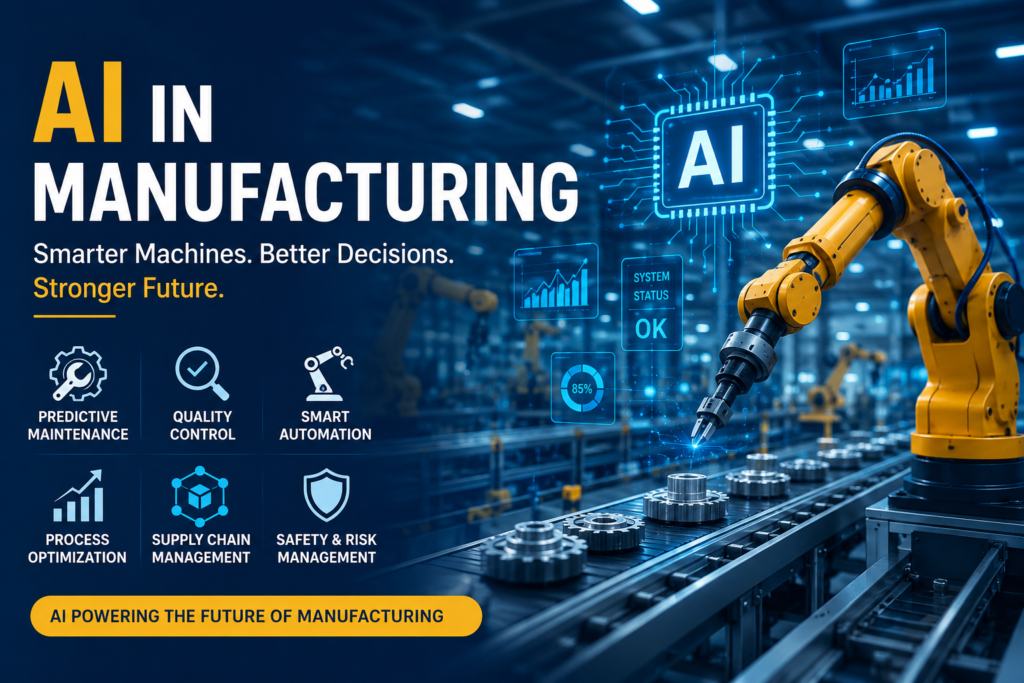
Artificial Intelligence (AI) in
Manufacturing Industry
Introduction
Artificial Intelligence (AI) is transforming the manufacturing industry
by making production processes smarter, faster, safer, and more efficient. AI
enables machines and systems to learn from data, identify patterns, make
decisions, and automate complex tasks with minimal human intervention. What is AI
in Manufacturing?
What is AI in Manufacturing? Manufacturing companies worldwide are adopting AI technologies to improve productivity, reduce costs, enhance product quality, and gain a competitive advantage in the era of Industry 4.0.
What is AI in Manufacturing?
AI in manufacturing refers to the use of advanced technologies such as:
- Machine Learning (ML)
- Deep Learning
- Computer Vision
- Robotics
- Predictive Analytics
- Internet of Things (IoT)
- Natural Language Processing (NLP)
These technologies help manufacturers analyze data, automate operations,
predict failures, and optimize production processes.
Why AI is Important in
Manufacturing
Traditional manufacturing often faces challenges such as:
- Equipment failures
- Production delays
- Quality defects
- High operational costs
- Supply chain disruptions
- Human errors
AI helps solve these challenges by providing intelligent automation and
real-time decision-making capabilities.
Website: https://elearningaischool.com
Major Applications of AI in
Manufacturing
1. Predictive Maintenance
AI monitors machinery and equipment continuously.
Benefits:
- Predicts machine failures before
breakdown
- Reduces downtime
- Extends equipment lifespan
- Minimizes maintenance costs
Example:
AI sensors detect unusual vibration in a motor and alert technicians
before failure occurs.
2. Quality Control and Inspection
AI-powered computer vision systems inspect products automatically.
Benefits:
- Detects defects quickly
- Improves product quality
- Reduces waste
- Increases customer satisfaction
Example:
AI cameras inspect automobile parts and identify microscopic defects.
3. Smart Robotics
AI-powered robots can perform repetitive and complex manufacturing tasks.
Benefits:
- Faster production
- Higher accuracy
- Reduced labor costs
- Improved workplace safety
Example:
Robotic arms assemble electronic devices with precision.
4. Production Planning and Scheduling
AI analyzes production data and recommends optimal schedules.
Benefits:
- Improved workflow
- Better resource utilization
- Reduced production delays
- Increased efficiency
Example:
AI automatically adjusts production schedules based on demand forecasts.
5. Supply Chain Optimization
AI improves supply chain visibility and efficiency.
Benefits:
- Better inventory management
- Accurate demand forecasting
- Reduced stock shortages
- Lower logistics costs
Example:
AI predicts customer demand and adjusts inventory levels automatically.
6. Energy Management
AI helps manufacturers reduce energy consumption.
Benefits:
- Lower electricity costs
- Reduced carbon emissions
- Sustainable operations
- Improved environmental compliance
Example:
AI adjusts machine operation schedules to optimize power consumption.
7. Workplace Safety
AI systems monitor factory environments and worker activities.
Benefits:
- Detects unsafe conditions
- Prevents accidents
- Improves worker safety
- Ensures regulatory compliance
Example:
AI cameras detect whether workers are wearing safety equipment.
8. Digital Twin Technology
A Digital Twin is a virtual replica of a machine, production line, or
factory.
Benefits:
- Simulates operations
- Predicts performance issues
- Improves maintenance planning
- Reduces operational risks
Example:
Manufacturers test process changes in a digital model before
implementation.
Benefits of AI in Manufacturing
Increased Productivity
AI automates repetitive tasks and improves production speed.
Better Product Quality
AI detects defects and ensures consistent quality standards.
Reduced Operational Costs
Automation and predictive maintenance lower expenses.
Faster Decision Making
Real-time data analysis enables quicker responses.
Enhanced Safety
AI identifies risks and prevents workplace accidents.
Reduced Downtime
Predictive analytics help avoid unexpected machine failures.
Improved Customer Satisfaction
Higher quality products lead to happier customers.
Sustainable Manufacturing
AI optimizes energy use and reduces waste.
AI Technologies Used in
Manufacturing
Machine Learning (ML)
Learns from historical production data.
Deep Learning
Processes complex manufacturing information.
Computer Vision
Analyzes images and videos for inspection.
Robotics
Automates manufacturing tasks.
IoT (Internet of Things)
Connects machines and sensors.
Predictive Analytics
Forecasts future events and maintenance needs.
Natural Language Processing (NLP)
Supports reporting and customer interactions.
Digital Twins
Creates virtual models of physical assets.
Real-World Examples of AI in
Manufacturing
Automotive Industry
- Automated vehicle assembly
- Defect detection
- Predictive maintenance
Electronics Manufacturing
- PCB inspection
- Smart assembly lines
- Automated testing
Pharmaceutical Manufacturing
- Drug production monitoring
- Quality assurance
- Regulatory compliance
Food and Beverage Industry
- Product quality inspection
- Packaging automation
- Demand forecasting
Textile Industry
- Fabric defect detection
- Automated cutting systems
- Inventory optimization
Future of AI in Manufacturing
The future of manufacturing is intelligent, connected, and autonomous.
Future developments include:
- Fully automated smart factories
- Collaborative robots (Cobots)
- Self-learning production systems
- AI-powered digital twins
- Advanced predictive maintenance
- Sustainable manufacturing
operations
- Real-time factory optimization
AI will continue to drive innovation, efficiency, and competitiveness
across global manufacturing industries.
Career Opportunities in AI
Manufacturing
As AI adoption grows, demand for skilled professionals is increasing.
Popular Job Roles:
- AI Engineer
- Machine Learning Engineer
- Manufacturing Data Analyst
- Robotics Engineer
- Automation Engineer
- Computer Vision Engineer
- Industrial AI Specialist
- IoT Engineer
- Digital Twin Developer
- Smart Factory Consultant
Conclusion
Artificial Intelligence is revolutionizing the manufacturing industry by
enabling smarter machines, intelligent automation, predictive maintenance, and
improved decision-making. Organizations that embrace AI can achieve higher
productivity, lower costs, better product quality, enhanced safety, and
long-term business growth.
AI is not replacing manufacturing—it is making manufacturing smarter,
faster, safer, and more efficient for the future.