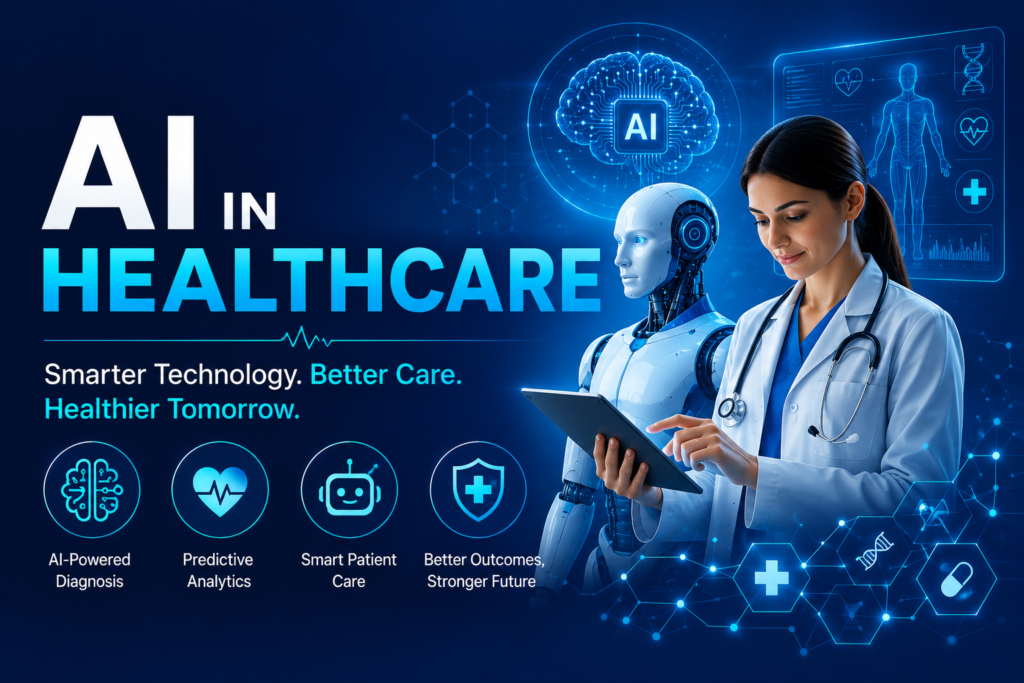
Artificial Intelligence (AI) in Healthcare: Transforming the Future of Medical Care
AI in Healthcare, Artificial Intelligence in Healthcare, Healthcare AI Solutions, AI Medical Diagnosis, AI in Hospitals, Machine Learning in Healthcare, AI Healthcare Applications, Future of AI in Medicine, Healthcare Technology, Digital Health Innovation.
Website: https://elearningaischool.com
Introduction
Artificial Intelligence (AI) is revolutionizing the healthcare industry by improving patient care, enhancing medical diagnostics, streamlining hospital operations, and accelerating medical research. Healthcare organizations worldwide are increasingly adopting AI-powered solutions to address challenges such as rising healthcare costs, staff shortages, growing patient populations, and the need for faster and more accurate diagnoses. AI technologies are helping healthcare professionals make informed decisions, reduce errors, and deliver personalized treatment plans that improve patient outcomes. AI has moved beyond experimental applications and is now actively supporting doctors, nurses, researchers, and healthcare administrators in everyday clinical practice.
What is AI in Healthcare?
AI in healthcare refers to the use of advanced technologies such as Machine Learning (ML), Deep Learning, Computer Vision, Natural Language Processing (NLP), Robotics, Predictive Analytics, and Generative AI to analyze medical data, assist in diagnosis, automate tasks, and improve healthcare delivery. These systems can learn from vast amounts of healthcare information, identify patterns, predict outcomes, and support medical professionals in making data-driven decisions.
Healthcare AI systems can process:
- Electronic Health Records (EHRs)
- Medical Images
- Laboratory Reports
- Clinical Notes
- Genomic Data
- Wearable Device Data
- Real-Time Patient Monitoring Information
Why AI is Important in Healthcare
The healthcare sector faces numerous challenges:
- Growing patient populations
- Shortage of healthcare professionals
- Rising treatment costs
- Diagnostic errors
- Administrative burdens
- Increasing chronic diseases
- Complex medical data management
AI helps address these issues by enabling faster diagnoses, improving efficiency, reducing operational costs, and enhancing patient experiences. Healthcare systems worldwide are increasingly using AI to improve both clinical and administrative outcomes.
Major Applications of AI in Healthcare
1. Medical Diagnosis and Disease Detection
AI systems can analyze medical images, laboratory reports, and patient records to identify diseases with high accuracy.
Benefits
- Faster diagnosis
- Improved accuracy
- Early disease detection
- Reduced diagnostic errors
Examples
- Cancer detection
- Heart disease diagnosis
- Diabetic retinopathy screening
- Skin cancer identification
- Lung disease detection
AI-powered imaging systems can identify abnormalities that may be difficult for the human eye to detect.
2. Medical Imaging and Radiology
Medical imaging generates enormous volumes of data. AI assists radiologists by analyzing:
- X-rays
- CT scans
- MRI scans
- Ultrasounds
- Mammograms
Benefits
- Faster image analysis
- Increased diagnostic confidence
- Improved patient outcomes
- Reduced workload for specialists
AI is now one of the most mature applications in healthcare imaging and diagnostics.
3. Predictive Analytics
Predictive AI models analyze historical and real-time patient data to forecast future health risks.
Benefits
- Early intervention
- Reduced hospital readmissions
- Better chronic disease management
- Improved treatment planning
Examples
- Predicting heart attacks
- Identifying sepsis risk
- Monitoring ICU patients
- Forecasting disease progression
Recent AI-based cardiovascular tools are helping identify hidden heart attack risks years before symptoms appear.
4. Personalized Treatment Plans
Every patient is unique. AI helps doctors create customized treatment strategies based on:
- Medical history
- Genetics
- Lifestyle factors
- Treatment responses
Benefits
- Improved treatment effectiveness
- Reduced side effects
- Better patient outcomes
- Precision medicine
Personalized healthcare is becoming a major focus area for AI-powered medical systems.
5. Drug Discovery and Development
Developing new medicines is expensive and time-consuming.
AI accelerates pharmaceutical research by:
- Analyzing molecular structures
- Identifying drug candidates
- Predicting drug effectiveness
- Optimizing clinical trials
Benefits
- Faster drug development
- Reduced research costs
- Improved success rates
- Accelerated innovation
AI is helping pharmaceutical companies bring life-saving treatments to market more efficiently.
6. Virtual Health Assistants and Chatbots
AI-powered virtual assistants provide patients with immediate healthcare support.
Functions
- Appointment scheduling
- Medication reminders
- Symptom checking
- Health education
- Patient engagement
Benefits
- 24/7 availability
- Reduced administrative workload
- Improved patient satisfaction
AI assistants are becoming an important part of modern digital healthcare ecosystems.
7. Remote Patient Monitoring
Wearable devices and IoT sensors continuously collect health information.
Monitored Data
- Heart rate
- Blood pressure
- Oxygen levels
- Glucose levels
- Sleep patterns
Benefits
- Continuous monitoring
- Early detection of health issues
- Reduced hospital visits
- Improved chronic disease management
Remote healthcare is becoming increasingly important for elderly and high-risk patients.
8. Robotic Surgery
AI-assisted robotic systems support surgeons during complex procedures.
Benefits
- Enhanced precision
- Smaller incisions
- Faster recovery
- Reduced complications
- Improved surgical outcomes
Robotic-assisted surgeries are widely used in specialties such as cardiology, orthopedics, and urology.
9. Hospital Administration and Workflow Automation
Healthcare professionals spend significant time on administrative tasks.
AI automates:
- Medical coding
- Claims processing
- Documentation
- Scheduling
- Billing management
Benefits
- Reduced paperwork
- Increased efficiency
- Lower operational costs
- Reduced staff burnout
AI is helping healthcare organizations optimize resources and improve productivity.
Benefits of AI in Healthcare
Improved Diagnostic Accuracy
AI assists doctors in identifying diseases earlier and more accurately.
Faster Healthcare Delivery
Automation reduces waiting times and speeds up decision-making.
Enhanced Patient Care
Personalized treatment plans improve patient outcomes.
Reduced Healthcare Costs
AI automates repetitive tasks and improves operational efficiency.
Better Resource Management
Hospitals can optimize staffing, equipment, and facilities.
Early Disease Detection
Predictive analytics help identify health risks before symptoms appear.
Reduced Medical Errors
AI provides decision support and identifies potential mistakes.
Increased Accessibility
Virtual healthcare services expand access to medical care.
AI Technologies Used in Healthcare
Machine Learning (ML)
Learns patterns from healthcare data.
Deep Learning
Processes complex medical information.
Natural Language Processing (NLP)
Analyzes clinical notes and medical records.
Computer Vision
Interprets medical images and scans.
Predictive Analytics
Forecasts future medical events.
Robotics
Supports surgery and patient care.
Internet of Things (IoT)
Connects wearable and monitoring devices.
Generative AI
Assists in clinical documentation and healthcare communication.
Real-World Examples of AI in Healthcare
Radiology
- Tumor detection
- Fracture identification
- Lung disease screening
Cardiology
- Heart disease prediction
- ECG analysis
- Cardiovascular risk assessment
Oncology
- Cancer diagnosis
- Treatment planning
- Precision medicine
Ophthalmology
- Diabetic retinopathy detection
- Vision screening
Pharmaceutical Industry
- Drug discovery
- Clinical trial optimization
Public Health
- Disease outbreak prediction
- Population health analytics
Healthcare leaders increasingly view AI as a tool that enhances clinicians rather than replacing them.
Challenges of AI in Healthcare
Despite its advantages, AI adoption presents several challenges:
- Data privacy concerns
- Cybersecurity risks
- Algorithm bias
- Regulatory compliance
- High implementation costs
- Integration with existing systems
- Ethical considerations
Healthcare organizations must ensure AI systems are transparent, secure, and fair.
Future of AI in Healthcare
The future of healthcare is increasingly intelligent, connected, and personalized.
Emerging Trends
- AI-powered hospitals
- Digital twins for patient simulation
- Personalized medicine
- AI-assisted diagnostics
- Autonomous healthcare systems
- Smart wearable devices
- Advanced robotic surgery
- Generative AI for clinical support
Experts believe AI will continue improving healthcare quality while helping address global shortages of healthcare professionals.
Career Opportunities in AI Healthcare
Growing AI adoption is creating significant demand for skilled professionals.
Popular Job Roles
- AI Engineer
- Machine Learning Engineer
- Healthcare Data Scientist
- Clinical AI Specialist
- Healthcare Analyst
- Medical Imaging Engineer
- AI Research Scientist
- Health Informatics Specialist
- Digital Health Consultant
- Healthcare Automation Engineer
Conclusion
Artificial Intelligence is transforming healthcare by enabling faster diagnoses, personalized treatments, predictive analytics, robotic surgery, and intelligent hospital operations. By combining human expertise with advanced technology, AI is helping healthcare providers deliver safer, more efficient, and more accessible care. As healthcare continues to evolve, AI will play a critical role in improving patient outcomes, reducing costs, accelerating medical innovation, and shaping the future of global healthcare. Organizations that embrace AI today will be better positioned to provide world-class healthcare services in the years ahead.