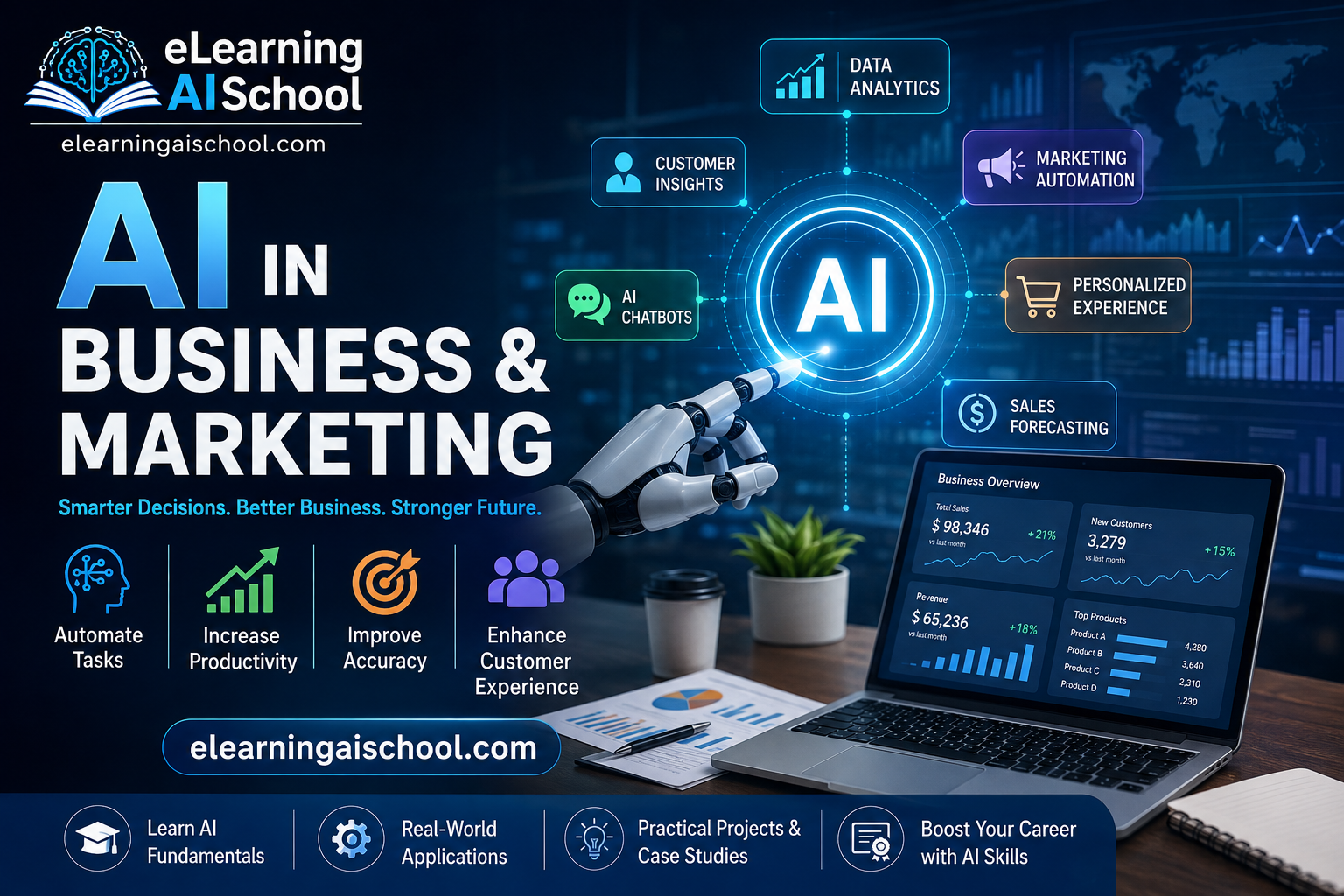
Introduction, AI Fundamentals, Business Applications, and Marketing Basics
Introduction
Artificial Intelligence (AI) has become one of the most transformative technologies in the modern business world. Organizations of all sizes—from startups and small businesses to multinational corporations—are adopting AI to automate processes, improve customer experiences, increase productivity, and make smarter decisions based on data.
In 2026, AI is no longer a futuristic concept. It is a practical business tool used every day for customer service, digital marketing, sales forecasting, financial analysis, human resources, cybersecurity, supply chain management, and product development. Businesses that integrate AI effectively can respond faster to market changes, reduce costs, and create personalized experiences for customers.
Marketing has also undergone a major transformation. AI enables businesses to analyze customer behavior, optimize advertising campaigns, generate content, personalize recommendations, and automate repetitive marketing tasks. Instead of relying only on manual processes, organizations now use AI to understand consumer preferences and deliver the right message to the right audience at the right time.
Whether you are a student, entrepreneur, marketer, business owner, or corporate professional, understanding AI is becoming an essential skill for success in today's digital economy.
What is Artificial Intelligence (AI)?
Artificial Intelligence (AI) is a branch of computer science that enables machines and software to perform tasks that typically require human intelligence.
These tasks include:
- Learning from data
- Problem solving
- Decision making
- Language understanding
- Image recognition
- Speech recognition
- Predictive analysis
- Content generation
- Process automation
Unlike traditional software that follows fixed rules, AI systems learn from data and improve their performance over time.
Evolution of AI in Business
1950–1980: Early Research
The concept of intelligent machines emerged, but business applications were limited due to low computing power.
1980–2000: Expert Systems
Businesses began using expert systems to assist with:
- Financial decisions
- Medical diagnosis
- Manufacturing
- Customer support
2000–2015: Big Data Revolution
The growth of cloud computing and big data enabled businesses to collect and analyze vast amounts of customer information.
AI became useful for:
- Search engines
- Recommendation systems
- Fraud detection
- Customer analytics
2016–2026: AI Everywhere
Generative AI, machine learning, cloud computing, and automation have accelerated AI adoption across industries.
Businesses now use AI for:
- Marketing automation
- Customer service
- Product recommendations
- Financial forecasting
- Sales optimization
- Predictive maintenance
- Business intelligence
- Workflow automation
Why AI is Important in Business
Businesses operate in highly competitive environments where speed, efficiency, and customer satisfaction are critical.
AI helps organizations:
- Reduce operational costs
- Improve decision-making
- Increase employee productivity
- Enhance customer experiences
- Automate repetitive tasks
- Detect fraud
- Predict market trends
- Improve profitability
Companies using AI effectively often gain a competitive advantage through faster insights and more personalized services.
Core AI Technologies Used in Business
Machine Learning (ML)
Machine Learning enables systems to learn from historical data and make predictions.
Business applications include:
- Sales forecasting
- Demand prediction
- Customer segmentation
- Fraud detection
Natural Language Processing (NLP)
NLP allows computers to understand and generate human language.
Applications include:
- Chatbots
- Email classification
- Customer support
- Language translation
- Sentiment analysis
Computer Vision
Computer Vision enables machines to analyze images and videos.
Business uses include:
- Product quality inspection
- Facial recognition
- Retail shelf monitoring
- Security surveillance
- Document scanning
Predictive Analytics
AI predicts future outcomes using historical data.
Examples include:
- Customer purchasing behavior
- Inventory demand
- Employee turnover
- Equipment maintenance
- Financial forecasting
Robotic Process Automation (RPA)
RPA automates repetitive office tasks such as:
- Invoice processing
- Data entry
- Payroll
- Report generation
- Customer onboarding
When combined with AI, automation becomes more intelligent and adaptable.
AI in Small Businesses
AI is no longer limited to large corporations. Affordable cloud-based AI services allow small businesses to compete more effectively.
Benefits
- Automated customer support
- Email marketing
- Sales forecasting
- Social media management
- Bookkeeping assistance
- Customer analytics
Example
A small online clothing store can use AI to:
- Recommend products
- Answer customer questions
- Predict inventory needs
- Send personalized promotional emails
This improves customer satisfaction while reducing manual work.
AI in Large Enterprises
Large organizations use AI to manage complex operations across departments.
Applications include:
- Enterprise resource planning
- Supply chain optimization
- Financial risk analysis
- Workforce management
- Global customer support
- Market intelligence
AI enables enterprises to process large volumes of data and make informed strategic decisions.
AI and Digital Transformation
Digital transformation involves integrating digital technologies into business processes. AI plays a central role in this transformation.
AI helps businesses:
- Automate workflows
- Improve collaboration
- Enhance data analysis
- Increase operational efficiency
- Deliver personalized customer experiences
Organizations adopting AI often become more agile and innovative.
AI in Business Decision-Making
Managers make better decisions when supported by accurate data.
AI assists by:
- Identifying trends
- Forecasting outcomes
- Evaluating risks
- Recommending actions
- Detecting anomalies
Rather than replacing human judgment, AI provides insights that support informed decision-making.
AI in Customer Relationship Management (CRM)
CRM systems manage customer interactions throughout the customer lifecycle.
AI enhances CRM by:
- Predicting customer needs
- Prioritizing sales leads
- Recommending products
- Automating follow-ups
- Analyzing customer sentiment
- Identifying at-risk customers
Benefits include stronger customer relationships and improved retention.
AI in Sales
Sales teams use AI to improve productivity and close deals more effectively.
AI supports:
Lead Scoring
AI ranks leads based on their likelihood of becoming customers.
Sales Forecasting
AI predicts future sales using:
- Historical sales
- Market trends
- Seasonal demand
- Customer behavior
Sales Recommendations
AI suggests:
- Cross-selling opportunities
- Upselling opportunities
- Personalized product recommendations
- Next-best actions for sales representatives
AI in Marketing
Marketing is one of the fastest-growing applications of AI.
AI enables marketers to:
- Understand customer behavior
- Personalize campaigns
- Automate repetitive tasks
- Improve return on investment (ROI)
- Optimize advertising
- Measure campaign performance
AI helps businesses deliver relevant messages to the right audience at the right time.
AI in Customer Support
Customer service is increasingly powered by AI.
Applications include:
- Intelligent chatbots
- Virtual assistants
- Automated ticket routing
- Voice assistants
- Self-service knowledge bases
- Sentiment analysis
Benefits:
- Faster response times
- 24/7 availability
- Reduced support costs
- Improved customer satisfaction
Complex issues can be escalated to human agents when needed.
AI Chatbots and Virtual Assistants
AI chatbots assist customers by answering common questions such as:
- Product information
- Order tracking
- Return policies
- Appointment booking
- Technical support
Advantages
- Instant responses
- Lower operational costs
- Consistent service
- Scalability during peak demand
AI in Personalization
Modern customers expect personalized experiences.
AI analyzes:
- Browsing history
- Purchase history
- Preferences
- Location
- Device usage
- Customer behavior
It then personalizes:
- Product recommendations
- Website content
- Emails
- Promotions
- Advertisements
Personalization improves customer engagement and loyalty.
AI in Business Analytics
Businesses generate large amounts of data every day.
AI transforms this data into actionable insights by identifying:
- Sales trends
- Customer preferences
- Operational bottlenecks
- Market opportunities
- Performance indicators
Business leaders can make faster and more informed decisions based on these insights.
Benefits of AI in Business
| Traditional Business | AI-Powered Business |
|---|---|
| Manual data analysis | Automated analytics |
| General marketing | Personalized marketing |
| Fixed customer service hours | 24/7 AI support |
| Manual forecasting | Predictive forecasting |
| Generic product recommendations | AI-driven recommendations |
| Reactive decision-making | Data-driven proactive decisions |
| Repetitive administrative tasks | Intelligent automation |
Challenges of AI Adoption
While AI offers significant advantages, businesses should also consider:
- Data privacy and security
- Implementation costs
- Employee training
- Integration with existing systems
- AI bias
- Ethical considerations
- Change management
- Regulatory compliance
A successful AI strategy combines technology with skilled people and clear business objectives.
Best Practices for Using AI in Business
- Define clear business goals before implementing AI.
- Start with small pilot projects and scale gradually.
- Ensure high-quality data for accurate AI results.
- Train employees to work effectively with AI tools.
- Maintain human oversight for important decisions.
- Protect customer and business data.
- Measure performance using key business metrics.
- Continuously monitor and improve AI systems.
AI in Digital Marketing & Advertising
Introduction to AI in Digital Marketing
Digital marketing has changed dramatically with the adoption of Artificial Intelligence (AI). Traditional marketing relied on manual research, broad audience targeting, and historical data. Today, AI enables businesses to analyze customer behavior in real time, automate campaigns, personalize content, and optimize advertising performance.
In 2026, businesses use AI to improve customer engagement, increase conversion rates, reduce marketing costs, and make faster, data-driven decisions. AI helps marketers reach the right audience with the right message at the right time across websites, social media, search engines, email, and mobile apps.
What is AI in Digital Marketing?
AI in digital marketing refers to the use of intelligent software that can analyze large datasets, predict customer behavior, automate repetitive tasks, and improve marketing performance.
AI helps marketers:
- Analyze customer preferences
- Predict buying behavior
- Create personalized campaigns
- Optimize advertising budgets
- Generate content
- Improve customer engagement
- Measure campaign performance
Why AI is Important in Marketing
Modern consumers expect personalized and relevant experiences. AI enables businesses to:
- Understand customer needs
- Deliver personalized recommendations
- Automate marketing activities
- Improve return on investment (ROI)
- Reduce manual work
- Increase sales conversions
- Strengthen customer loyalty
AI in Search Engine Optimization (SEO)
SEO helps websites rank higher in search engine results. AI assists marketers by improving keyword research, content optimization, technical SEO, and performance analysis.
AI for Keyword Research
AI identifies:
- High-ranking keywords
- Long-tail keywords
- Search trends
- User intent
- Competitor keywords
This helps create content that aligns with what users are searching for.
AI for Content Optimization
AI analyzes content and suggests improvements such as:
- Better headings
- Improved readability
- Keyword placement
- Internal linking opportunities
- Meta titles
- Meta descriptions
Optimized content has a greater chance of ranking well in search engines.
AI for Technical SEO
AI tools help identify:
- Broken links
- Slow-loading pages
- Duplicate content
- Mobile usability issues
- Crawl errors
- Missing image alt text
These improvements enhance website performance and user experience.
AI in Content Marketing
Content marketing is essential for attracting and retaining customers. AI accelerates the content creation process while helping maintain quality.
AI Content Planning
AI analyzes:
- Audience interests
- Trending topics
- Competitor content
- Search demand
It recommends blog topics, article structures, and publishing schedules.
AI Content Creation
AI assists with creating:
- Blog articles
- Product descriptions
- Website content
- Email newsletters
- Social media captions
- Marketing copy
Human review remains important to ensure accuracy, originality, and brand consistency.
AI Content Personalization
Different customers have different interests. AI delivers personalized content based on:
- Browsing history
- Purchase history
- Demographics
- Interests
- Device usage
- Geographic location
Personalized experiences improve engagement and customer satisfaction.
AI in Social Media Marketing
Social media platforms generate vast amounts of user data. AI helps businesses use this data effectively.
AI for Content Scheduling
AI recommends the best times to publish content based on audience activity.
Benefits include:
- Higher engagement
- Increased visibility
- Better reach
- Improved consistency
AI for Audience Analysis
AI analyzes:
- Likes
- Comments
- Shares
- Followers
- Demographics
- Engagement trends
These insights help marketers refine their strategies.
AI for Social Listening
AI monitors online conversations about:
- Brands
- Products
- Competitors
- Industry trends
This helps businesses understand customer opinions and respond proactively.
AI in Email Marketing
Email remains one of the highest-performing digital marketing channels. AI enhances every stage of email campaigns.
Personalized Emails
AI customizes:
- Subject lines
- Product recommendations
- Promotional offers
- Content
- Send times
Personalized emails often achieve higher open and click-through rates.
Automated Email Campaigns
AI automates:
- Welcome emails
- Abandoned cart reminders
- Birthday messages
- Renewal reminders
- Follow-up sequences
Automation saves time while maintaining consistent customer communication.
AI in Pay-Per-Click (PPC) Advertising
Online advertising platforms increasingly use AI to optimize campaigns.
AI helps with:
- Bid management
- Audience targeting
- Budget allocation
- Ad placement
- Conversion optimization
- Performance reporting
This improves advertising efficiency and maximizes ROI.
AI in Customer Analytics
Understanding customers is fundamental to successful marketing.
AI analyzes:
- Purchase history
- Website activity
- Mobile app usage
- Customer feedback
- Support interactions
- Shopping behavior
Businesses use these insights to improve products, services, and marketing strategies.
AI in Customer Segmentation
Instead of grouping customers manually, AI automatically segments audiences based on:
- Age
- Location
- Interests
- Spending habits
- Purchase frequency
- Online behavior
Marketers can create more targeted campaigns for each segment.
AI in Product Recommendations
Recommendation engines suggest products based on customer preferences.
Examples include:
- Related products
- Frequently bought together
- Recently viewed items
- Personalized recommendations
Benefits:
- Increased sales
- Higher customer satisfaction
- Improved average order value
AI in Marketing Automation
Marketing automation allows businesses to manage campaigns with minimal manual effort.
AI automates:
- Lead nurturing
- Social media posting
- Email campaigns
- Customer follow-ups
- Campaign reporting
- Audience targeting
Automation enables marketing teams to focus on strategy and creativity.
AI in Lead Generation
Generating quality leads is one of the most important marketing goals.
AI identifies potential customers by analyzing:
- Website visits
- Content downloads
- Email engagement
- Social media activity
- Purchase intent
AI also ranks leads according to their likelihood of becoming customers, helping sales teams prioritize outreach.
AI in Customer Journey Mapping
Customers interact with businesses through multiple channels before making a purchase.
AI tracks these interactions across:
- Websites
- Mobile apps
- Social media
- Customer support
- Online advertisements
Businesses gain a complete view of the customer journey and can improve each stage of the experience.
AI in Brand Management
Maintaining a positive brand image is essential.
AI monitors:
- Customer reviews
- Social media mentions
- Online ratings
- News articles
- Competitor activities
Businesses can quickly respond to feedback, manage their reputation, and identify emerging opportunities.
AI in Sentiment Analysis
AI evaluates customer opinions by analyzing text from:
- Reviews
- Social media posts
- Surveys
- Emails
- Chat conversations
It classifies feedback as:
- Positive
- Neutral
- Negative
This helps businesses understand public perception and improve customer satisfaction.
AI in Influencer Marketing
AI assists businesses in selecting suitable influencers by analyzing:
- Audience demographics
- Engagement rates
- Content quality
- Brand alignment
- Authenticity
- Campaign performance
This helps companies collaborate with creators whose audiences match their target market.
AI in Video Marketing
Video has become one of the most effective forms of digital content.
AI supports video marketing by:
- Generating scripts
- Creating subtitles
- Translating videos
- Editing footage
- Personalizing video content
- Analyzing viewer engagement
These capabilities reduce production time and improve accessibility.
AI in Conversational Marketing
Conversational marketing focuses on real-time communication with customers.
AI-powered chatbots and virtual assistants can:
- Answer questions
- Recommend products
- Schedule appointments
- Collect customer information
- Resolve common issues
- Transfer complex queries to human agents
This creates faster and more convenient customer interactions.
AI for Marketing Performance Measurement
AI provides marketers with dashboards that track:
- Website traffic
- Conversion rates
- Customer acquisition cost
- Return on ad spend (ROAS)
- Customer lifetime value
- Campaign engagement
These insights support continuous improvement and more effective budget allocation.
Real-World Example
A clothing retailer launches a new collection.
AI helps by:
- Identifying trending fashion keywords.
- Segmenting customers based on past purchases.
- Sending personalized email recommendations.
- Running targeted social media advertisements.
- Optimizing advertising bids automatically.
- Recommending complementary products.
- Measuring campaign performance in real time.
The result is higher engagement, improved conversions, and more efficient use of marketing resources.
Benefits of AI in Digital Marketing
| Traditional Marketing | AI-Powered Marketing |
|---|---|
| Broad audience targeting | Personalized targeting |
| Manual campaign management | Automated workflows |
| Generic advertisements | Personalized advertisements |
| Limited customer insights | Real-time analytics |
| Manual reporting | Automated dashboards |
| Reactive decisions | Predictive marketing |
| Fixed schedules | AI-optimized timing |
Challenges of AI in Marketing
While AI offers significant benefits, marketers should consider:
- Data privacy and compliance
- Maintaining customer trust
- Avoiding biased AI models
- Over-automation that reduces human connection
- Integration with existing systems
- Ensuring content accuracy
- Managing implementation costs
Successful marketing combines AI efficiency with human creativity and strategic thinking.
Best Practices for AI in Marketing
- Define clear marketing objectives.
- Use high-quality and ethically collected data.
- Review AI-generated content before publishing.
- Maintain a consistent brand voice.
- Monitor campaign performance regularly.
- Protect customer privacy.
- Balance automation with personalized human interaction.
- Continuously test and optimize campaigns.
AI Across Business Operations
Introduction
Artificial Intelligence (AI) is transforming every department within an organization—not just marketing. Businesses now use AI to streamline operations, improve decision-making, reduce costs, enhance customer satisfaction, and increase productivity. From Human Resources (HR) and Finance to Supply Chain Management and Retail, AI is helping organizations work smarter and compete more effectively.
In this section, we'll explore how AI is being used across core business functions and how it creates value for organizations of all sizes.
AI in Human Resources (HR)
Human Resources departments manage recruitment, employee engagement, performance evaluation, learning, and workforce planning. AI simplifies many of these processes.
AI in Recruitment
AI helps HR teams:
- Screen resumes automatically
- Match candidate skills with job requirements
- Rank applicants
- Schedule interviews
- Reduce repetitive administrative work
Benefits
- Faster hiring process
- Improved candidate matching
- Reduced recruitment costs
- Better hiring decisions
AI in Employee Onboarding
AI assists new employees by:
- Providing digital orientation
- Answering HR-related questions
- Explaining company policies
- Managing onboarding checklists
- Recommending training materials
This creates a smoother onboarding experience.
AI in Employee Performance Management
AI analyzes:
- Productivity
- Goal achievement
- Skill development
- Attendance
- Project completion
Managers receive insights that support fair and objective performance evaluations.
AI in Employee Learning and Development
AI creates personalized learning paths based on:
- Employee roles
- Skills
- Career goals
- Performance data
Organizations can deliver targeted training programs that improve workforce capabilities.
AI in Finance
Finance departments process large amounts of financial data. AI improves speed, accuracy, and decision-making.
Financial Forecasting
AI predicts:
- Revenue
- Expenses
- Cash flow
- Market trends
- Investment opportunities
This supports strategic financial planning.
Budget Planning
AI helps organizations:
- Create budgets
- Monitor spending
- Detect unusual expenses
- Optimize resource allocation
Expense Management
AI automatically processes:
- Receipts
- Expense claims
- Travel costs
- Employee reimbursements
Automation reduces manual work and errors.
AI in Accounting
Accounting professionals use AI to automate repetitive tasks.
Applications include:
- Invoice processing
- Bank reconciliation
- Tax calculations
- Financial reporting
- Compliance monitoring
- Document classification
Benefits:
- Faster processing
- Higher accuracy
- Reduced administrative workload
AI in Fraud Detection
Financial fraud continues to evolve. AI helps detect suspicious activity by analyzing transaction patterns.
AI identifies:
- Unusual purchases
- Account takeovers
- Identity theft attempts
- Duplicate transactions
- Payment fraud
Early detection helps reduce financial losses.
AI in Risk Management
Organizations face operational, financial, and cybersecurity risks.
AI evaluates:
- Market risks
- Credit risks
- Supply chain disruptions
- Operational risks
- Regulatory compliance
Predictive analytics allows businesses to prepare for potential challenges.
AI in Supply Chain Management
Supply chains involve suppliers, manufacturers, warehouses, transportation, and retailers.
AI improves supply chain efficiency through:
- Demand forecasting
- Inventory optimization
- Route planning
- Supplier analysis
- Delivery tracking
Benefits include lower costs and improved customer satisfaction.
AI for Demand Forecasting
AI predicts future demand using:
- Historical sales
- Seasonal trends
- Customer behavior
- Market conditions
Businesses can maintain optimal inventory levels and reduce shortages.
AI for Warehouse Management
AI supports warehouses by:
- Tracking inventory
- Optimizing storage locations
- Managing order fulfillment
- Predicting restocking needs
- Improving warehouse efficiency
Automation reduces delays and improves accuracy.
AI in Inventory Management
Maintaining the right inventory is essential for business success.
AI helps businesses:
- Predict stock requirements
- Reduce excess inventory
- Prevent stock shortages
- Optimize purchasing decisions
This minimizes waste and improves profitability.
AI in Manufacturing
Manufacturing companies use AI to improve production quality and operational efficiency.
Predictive Maintenance
AI monitors machinery and predicts when maintenance is needed.
Benefits:
- Reduced downtime
- Lower repair costs
- Longer equipment life
- Improved production efficiency
Quality Control
Computer vision systems inspect products for defects during manufacturing.
AI detects:
- Surface defects
- Incorrect assembly
- Dimensional errors
- Packaging issues
This improves product quality while reducing manual inspection.
Production Planning
AI optimizes:
- Production schedules
- Resource allocation
- Workforce planning
- Machine utilization
Manufacturers can respond more quickly to changing customer demand.
AI in Retail
Retail businesses use AI to improve customer experiences and operational efficiency.
Personalized Shopping
AI recommends products based on:
- Purchase history
- Browsing behavior
- Preferences
- Seasonal interests
Personalized recommendations increase customer satisfaction and sales.
Smart Pricing
AI analyzes:
- Competitor pricing
- Customer demand
- Inventory levels
- Market conditions
Businesses can adjust prices dynamically while remaining competitive.
Store Analytics
AI helps retailers understand:
- Customer movement
- Popular products
- Checkout efficiency
- Inventory turnover
These insights improve store layout and product placement.
AI in E-commerce
Online businesses rely heavily on AI.
Applications include:
- Product recommendations
- Personalized search results
- Customer support chatbots
- Fraud prevention
- Inventory management
- Automated marketing
AI enhances the online shopping experience while increasing operational efficiency.
AI in Business Intelligence (BI)
Business Intelligence transforms data into actionable insights.
AI analyzes:
- Sales performance
- Customer trends
- Operational metrics
- Market opportunities
- Financial performance
Executives use AI-powered dashboards to support strategic decisions.
AI in Project Management
Project managers oversee complex projects involving multiple teams and deadlines.
AI assists by:
- Predicting project risks
- Tracking progress
- Allocating resources
- Managing schedules
- Automating status reports
Teams can complete projects more efficiently.
AI in Productivity and Collaboration
Modern workplaces use AI to improve communication and productivity.
AI supports:
- Meeting summaries
- Task management
- Calendar scheduling
- Email organization
- Document search
- Workflow automation
Employees spend less time on repetitive tasks and more time on strategic work.
AI in Customer Experience (CX)
Customer experience is a major competitive advantage.
AI improves CX through:
- Personalized interactions
- Faster customer support
- Predictive recommendations
- Proactive issue resolution
- Omnichannel communication
Satisfied customers are more likely to remain loyal and recommend the business.
AI in Procurement
Procurement teams use AI to:
- Evaluate suppliers
- Compare prices
- Predict purchasing needs
- Monitor contracts
- Identify supply risks
AI helps organizations build more resilient supply chains.
AI in Business Communication
AI enhances communication by:
- Drafting emails
- Translating languages
- Summarizing meetings
- Organizing documents
- Generating reports
This improves collaboration across global teams.
AI in Decision Support Systems
Business leaders often face complex decisions.
AI provides:
- Scenario analysis
- Predictive models
- Market insights
- Risk assessments
- Strategic recommendations
Final decisions remain the responsibility of human leaders, with AI serving as a decision-support tool.
Real-World Business Example
A retail company integrates AI across its operations:
- AI forecasts product demand.
- Inventory levels are optimized automatically.
- Personalized product recommendations increase sales.
- Customer service chatbots answer common questions.
- Financial systems detect suspicious transactions.
- HR uses AI to screen job applicants.
- Executives monitor AI-powered business dashboards.
The result is improved efficiency, lower costs, and a better customer experience.
Benefits of AI Across Business Operations
| Traditional Operations | AI-Powered Operations |
|---|---|
| Manual recruitment | AI-assisted hiring |
| Manual accounting | Automated financial processing |
| Fixed inventory planning | Predictive inventory management |
| Reactive maintenance | Predictive maintenance |
| Manual quality inspection | AI-powered quality control |
| General customer service | Personalized customer support |
| Manual reporting | Real-time analytics dashboards |
Challenges of AI Adoption
Organizations should address several challenges:
- Data quality
- Integration with existing systems
- Employee training
- Cybersecurity
- Data privacy
- AI bias
- Regulatory compliance
- Change management
Successful implementation requires strong governance, skilled employees, and continuous evaluation.
Best Practices for AI Adoption
- Align AI projects with business goals.
- Start with high-impact use cases.
- Ensure data quality and security.
- Train employees to work with AI systems.
- Monitor AI performance regularly.
- Maintain transparency and ethical standards.
- Keep human oversight for critical decisions.
- Continuously improve AI models based on feedback.
AI Strategy, Ethics, Security, Governance & the Future of Business
Introduction
Artificial Intelligence (AI) has become a strategic asset for businesses across industries. While AI improves efficiency, productivity, and customer experiences, organizations must also address important considerations such as governance, ethics, privacy, cybersecurity, and workforce readiness.
A successful AI strategy is not only about implementing technology—it also requires responsible data management, employee training, compliance with regulations, and continuous evaluation of AI systems. Businesses that approach AI thoughtfully are more likely to achieve sustainable growth and maintain customer trust.
AI Strategy for Business Success
An AI strategy helps organizations align AI initiatives with business objectives.
Key Objectives
- Improve operational efficiency
- Enhance customer experience
- Increase revenue
- Reduce operational costs
- Automate repetitive tasks
- Support innovation
- Strengthen competitiveness
Steps to Build an AI Strategy
- Identify business challenges.
- Define measurable goals.
- Assess available data.
- Select appropriate AI solutions.
- Train employees.
- Implement pilot projects.
- Measure results.
- Scale successful initiatives.
AI Governance
AI governance refers to the policies, processes, and controls that guide the responsible development and use of AI.
Components of AI Governance
- AI policies
- Data governance
- Risk management
- Compliance monitoring
- Model evaluation
- Human oversight
- Accountability
Good governance helps organizations use AI responsibly while reducing operational and legal risks.
Responsible AI
Responsible AI means designing and using AI systems that are fair, transparent, secure, and aligned with organizational values.
Principles of Responsible AI
- Fairness
- Transparency
- Accountability
- Privacy protection
- Security
- Reliability
- Human oversight
- Continuous monitoring
Organizations should regularly evaluate AI systems to ensure they remain accurate and appropriate for their intended use.
AI Ethics in Business
Ethics play a central role in AI adoption.
Businesses should ensure AI:
- Treats customers fairly
- Avoids discrimination
- Respects privacy
- Supports informed decision-making
- Provides explainable outcomes where appropriate
Ethical AI strengthens customer confidence and long-term business sustainability.
Data Privacy
AI systems often process significant amounts of business and customer data.
Organizations should:
- Collect only necessary data
- Store data securely
- Limit access to authorized personnel
- Define clear data retention policies
- Inform users about data usage
- Comply with applicable privacy laws
Protecting personal information is essential for maintaining customer trust.
Cybersecurity and AI
AI plays a dual role in cybersecurity—it helps defend organizations while also requiring protection itself.
AI for Cybersecurity
AI supports:
- Threat detection
- Malware identification
- Network monitoring
- Fraud detection
- Phishing prevention
- Incident response
AI can detect unusual patterns much faster than traditional monitoring methods.
Securing AI Systems
Businesses should also protect AI models against:
- Unauthorized access
- Data manipulation
- Model theft
- Adversarial attacks
- System misuse
Regular security testing and access controls help reduce these risks.
AI Regulations and Compliance
Governments around the world are developing AI regulations focused on safety, transparency, accountability, and responsible innovation.
Businesses should:
- Stay informed about applicable regulations
- Document AI decision-making processes
- Conduct regular compliance reviews
- Maintain appropriate records
- Review high-impact AI applications carefully
Compliance helps reduce legal and reputational risks.
AI Risk Management
Every AI implementation involves potential risks.
Common Risks
- Inaccurate predictions
- Biased outcomes
- Poor-quality data
- Security vulnerabilities
- Operational disruptions
- Overdependence on automation
Organizations should regularly assess and mitigate these risks.
AI Return on Investment (ROI)
Measuring AI success is essential.
Key Performance Indicators (KPIs)
- Revenue growth
- Cost reduction
- Customer satisfaction
- Employee productivity
- Conversion rates
- Customer retention
- Process efficiency
- Error reduction
Tracking these metrics helps determine whether AI investments are delivering business value.
AI Change Management
Successful AI adoption depends on people as much as technology.
Organizations should:
- Communicate clearly about AI initiatives
- Involve employees early
- Provide training
- Address concerns
- Encourage collaboration
- Monitor adoption
A structured change management approach increases acceptance and improves results.
AI Skills for Business Professionals
As AI becomes more common, employees across departments need new skills.
Technical Skills
- Data literacy
- AI fundamentals
- Digital tools
- Analytics
- Automation concepts
Business Skills
- Strategic thinking
- Decision-making
- Customer understanding
- Process improvement
- Project management
Human Skills
- Creativity
- Critical thinking
- Communication
- Leadership
- Adaptability
- Ethical judgment
These skills complement AI rather than compete with it.
AI and the Future of Work
AI is changing how work is performed across industries.
Tasks Most Likely to Be Automated
- Data entry
- Report generation
- Routine customer support
- Scheduling
- Invoice processing
- Basic analysis
Human-Centered Tasks
People remain essential for:
- Leadership
- Innovation
- Complex decision-making
- Negotiation
- Relationship building
- Strategic planning
- Creative problem-solving
The future workplace is expected to combine human expertise with AI assistance.
AI for Innovation
AI accelerates innovation by helping businesses:
- Identify new market opportunities
- Analyze customer feedback
- Improve product design
- Test ideas more quickly
- Optimize research and development
Organizations can bring products and services to market faster while reducing development costs.
AI in Business Continuity
Unexpected disruptions such as natural disasters, cyber incidents, or supply chain interruptions can affect operations.
AI supports business continuity by:
- Predicting potential disruptions
- Monitoring operational risks
- Optimizing contingency plans
- Supporting rapid decision-making
- Improving resource allocation
AI in Sustainability
Businesses increasingly use AI to support sustainability goals.
Applications include:
- Energy optimization
- Waste reduction
- Carbon emissions monitoring
- Supply chain efficiency
- Smart logistics
- Resource conservation
AI helps organizations balance profitability with environmental responsibility.
Future AI Trends (2026–2035)
Several trends are expected to shape the future of AI in business.
Intelligent Automation
Automation will become more adaptive, handling increasingly complex workflows while working alongside employees.
Hyper-Personalization
Businesses will deliver highly customized experiences based on customer preferences, behavior, and context.
AI Agents
Autonomous AI systems capable of planning and executing multi-step business tasks are expected to become more common, with appropriate human oversight.
Predictive Decision Support
Executives will increasingly rely on AI to evaluate scenarios, forecast outcomes, and support strategic planning.
Industry-Specific AI
More AI solutions will be designed for sectors such as:
- Healthcare
- Finance
- Manufacturing
- Retail
- Education
- Agriculture
- Logistics
These systems will address specialized business needs.
AI Adoption Roadmap
Organizations can adopt AI gradually through a structured approach.
| Stage | Activities |
|---|---|
| Assessment | Identify business opportunities |
| Planning | Define objectives and success metrics |
| Pilot | Implement small AI projects |
| Evaluation | Measure outcomes and refine solutions |
| Expansion | Scale successful initiatives |
| Optimization | Continuously monitor and improve |
Benefits of Responsible AI Adoption
| Traditional Business | AI-Enabled Business |
|---|---|
| Reactive planning | Predictive planning |
| Manual decision support | AI-assisted insights |
| Limited automation | Intelligent automation |
| General customer engagement | Personalized experiences |
| Periodic reporting | Real-time dashboards |
| Isolated systems | Integrated digital workflows |
Challenges Businesses Must Address
Organizations implementing AI should prepare for:
- Data quality issues
- Employee skill gaps
- Technology integration
- Regulatory changes
- Cybersecurity threats
- Privacy concerns
- AI bias
- Managing organizational change
Addressing these challenges proactively improves long-term success.
Best Practices for AI Success
- Align AI initiatives with business strategy.
- Use high-quality, well-governed data.
- Protect customer and organizational information.
- Keep humans involved in important decisions.
- Train employees continuously.
- Monitor AI systems for accuracy and fairness.
- Measure business outcomes using clear KPIs.
- Update AI models regularly as business needs evolve.
AI Tools, Careers, Future Trends, FAQs, SEO Guide & Conclusion
Introduction
Artificial Intelligence has become one of the most valuable technologies in modern business and marketing. Organizations use AI to automate operations, improve customer experiences, enhance productivity, and make data-driven decisions. As AI continues to evolve, businesses that embrace responsible AI practices will be better positioned to innovate, compete, and grow.
This final section covers AI tools, career opportunities, certifications, future trends, best practices, frequently asked questions, SEO guidance, and a complete summary.
Top AI Tools for Business (2026)
The following categories represent widely used AI-powered business tools and platforms.
| Category | AI Applications |
|---|---|
| Customer Relationship Management (CRM) | Lead management, sales forecasting, customer analytics |
| Business Intelligence (BI) | Dashboards, reporting, predictive analytics |
| Accounting & Finance | Invoice processing, expense management, forecasting |
| Human Resources | Recruitment, onboarding, employee analytics |
| Project Management | Task automation, scheduling, reporting |
| Customer Support | AI chatbots, virtual assistants, ticket routing |
| Document Management | Document search, summarization, classification |
| Workflow Automation | Process automation, approvals, notifications |
| Meeting Productivity | Transcription, summaries, action items |
| Cybersecurity | Threat detection, fraud prevention, anomaly detection |
Top AI Tools for Marketing
AI has transformed digital marketing by making campaigns more intelligent and personalized.
SEO
AI supports:
- Keyword research
- Technical SEO audits
- Content optimization
- Competitor analysis
- Search trend analysis
Content Marketing
AI assists with:
- Blog writing
- Product descriptions
- Email copy
- Social media content
- Video scripts
- Marketing campaigns
Social Media
AI helps marketers:
- Schedule posts
- Analyze engagement
- Generate captions
- Track trends
- Monitor brand mentions
Email Marketing
AI improves:
- Subject line optimization
- Audience segmentation
- Personalized recommendations
- Automated campaigns
- Performance analysis
Advertising
AI supports:
- Audience targeting
- Bid optimization
- Budget allocation
- Campaign performance analysis
- Conversion prediction
AI Careers in Business
As AI adoption grows, new career opportunities continue to emerge.
Popular Career Options
AI Business Analyst
Responsibilities:
- Analyze business processes
- Recommend AI solutions
- Improve operational efficiency
AI Consultant
Responsibilities:
- Guide organizations through AI adoption
- Develop implementation strategies
- Evaluate AI opportunities
AI Product Manager
Responsibilities:
- Plan AI-powered products
- Coordinate development teams
- Define product strategy
Business Intelligence Analyst
Responsibilities:
- Analyze business data
- Create dashboards
- Support executive decision-making
Marketing Automation Specialist
Responsibilities:
- Manage automated campaigns
- Improve customer engagement
- Optimize digital marketing workflows
AI Operations Manager
Responsibilities:
- Oversee AI systems
- Monitor performance
- Ensure responsible deployment
AI Careers in Marketing
Marketing professionals increasingly combine traditional skills with AI expertise.
Career opportunities include:
- Digital Marketing Manager
- SEO Specialist
- Content Strategist
- Social Media Manager
- Marketing Data Analyst
- Customer Experience Manager
- Brand Manager
- E-commerce Manager
- Growth Marketing Specialist
- Marketing Technology (MarTech) Specialist
Essential Skills for Future Professionals
Technical Skills
- AI fundamentals
- Data analysis
- Digital marketing
- Analytics
- Automation
- Business intelligence
Business Skills
- Strategic thinking
- Customer relationship management
- Communication
- Project management
- Problem-solving
Soft Skills
- Creativity
- Critical thinking
- Leadership
- Adaptability
- Ethical decision-making
- Collaboration
AI Certifications
Professionals can strengthen their knowledge through AI and digital business certifications.
Popular learning areas include:
- Artificial Intelligence Fundamentals
- Machine Learning Basics
- Business Analytics
- Data Analytics
- Digital Marketing
- Cloud Computing
- Cybersecurity
- Project Management
- Business Intelligence
- Generative AI
When choosing a certification, consider the curriculum, practical projects, instructor quality, and industry relevance.
Business Best Practices for AI Adoption
Organizations should:
- Define measurable business objectives.
- Start with small pilot projects.
- Ensure high-quality data.
- Protect customer privacy.
- Train employees continuously.
- Keep humans involved in important decisions.
- Monitor AI performance regularly.
- Improve systems based on feedback.
Real-World Business Case Studies
Retail
A retail chain uses AI to forecast demand, optimize inventory, and personalize promotions, reducing stock shortages and improving customer satisfaction.
Banking
A financial institution applies AI to detect suspicious transactions, assess risk, and improve customer support through virtual assistants.
Healthcare
A healthcare provider uses AI to streamline appointment scheduling, analyze operational data, and support administrative decision-making.
Manufacturing
A manufacturer deploys AI for predictive maintenance, reducing equipment downtime and improving production efficiency.
E-commerce
An online retailer uses AI-powered recommendation systems and marketing automation to increase conversions and customer loyalty.
Future Trends (2026–2035)
The coming decade is expected to bring continued advances in AI.
Intelligent Business Automation
Routine processes will become increasingly automated while employees focus on strategic and creative work.
AI Agents
Organizations are expected to adopt AI systems capable of handling complex, multi-step workflows with appropriate human oversight.
Hyper-Personalization
Businesses will deliver highly customized experiences based on customer preferences, context, and behavior.
Predictive Business Intelligence
AI will provide more advanced forecasting to support planning, budgeting, and strategic decision-making.
Sustainable AI
Organizations will increasingly use AI to improve energy efficiency, reduce waste, and support environmental sustainability initiatives.
Advantages of AI in Business
- Increased productivity
- Better customer experiences
- Improved decision-making
- Faster business processes
- Reduced operational costs
- Better risk management
- Personalized marketing
- Enhanced innovation
- Scalable operations
- Competitive advantage
Limitations of AI
- Initial implementation costs
- Dependence on quality data
- Data privacy concerns
- Cybersecurity risks
- Need for employee training
- Potential bias in AI models
- Regulatory compliance requirements
- Human oversight remains necessary
Frequently Asked Questions (FAQs)
1. What is AI in business?
AI in business is the use of intelligent software to automate tasks, analyze data, improve decision-making, and enhance customer experiences.
2. How does AI help marketing?
AI improves SEO, content creation, advertising, personalization, customer analytics, and campaign optimization.
3. Can small businesses use AI?
Yes. Many AI tools are cloud-based and affordable, making them accessible to small businesses as well as large enterprises.
4. Will AI replace marketers?
AI automates repetitive tasks, but human creativity, strategic thinking, and relationship-building remain essential.
5. Is AI safe for business?
AI can be safe when organizations implement appropriate security, governance, privacy, and ethical practices.
6. Which industries benefit most from AI?
AI is widely used in healthcare, finance, retail, manufacturing, logistics, education, agriculture, hospitality, telecommunications, and professional services.
7. What skills are important for AI-powered workplaces?
Key skills include data literacy, critical thinking, communication, business strategy, digital marketing, analytics, and adaptability.
8. Can AI improve customer service?
Yes. AI chatbots, virtual assistants, and analytics help businesses provide faster, more personalized customer support.
9. Is AI expensive?
Costs vary depending on the solution. Many cloud-based AI services offer scalable pricing suitable for businesses of different sizes.
10. What is the future of AI in business?
AI is expected to become more integrated into business operations, supporting automation, decision-making, customer engagement, and innovation while continuing to require responsible governance.
Glossary
Artificial Intelligence (AI): Technology that enables machines to perform tasks associated with human intelligence.
Machine Learning (ML): AI techniques that learn patterns from data.
Business Intelligence (BI): Tools and methods for analyzing business data.
Customer Relationship Management (CRM): Systems for managing customer interactions and relationships.
Predictive Analytics: Using historical data to estimate future outcomes.
Automation: Using technology to perform tasks with minimal manual intervention.
Natural Language Processing (NLP): AI methods for understanding and generating human language.
Computer Vision: AI techniques that interpret images and video.
Complete Summary
Artificial Intelligence has become a fundamental driver of business transformation. It enables organizations to automate operations, personalize customer experiences, improve decision-making, enhance marketing effectiveness, and optimize resources. From startups to multinational enterprises, AI supports growth by combining data-driven insights with operational efficiency.
Successful AI adoption requires more than technology. Businesses should establish clear objectives, maintain strong governance, protect customer privacy, train employees, and ensure responsible human oversight. Organizations that embrace AI thoughtfully will be better prepared for the opportunities and challenges of the digital economy.