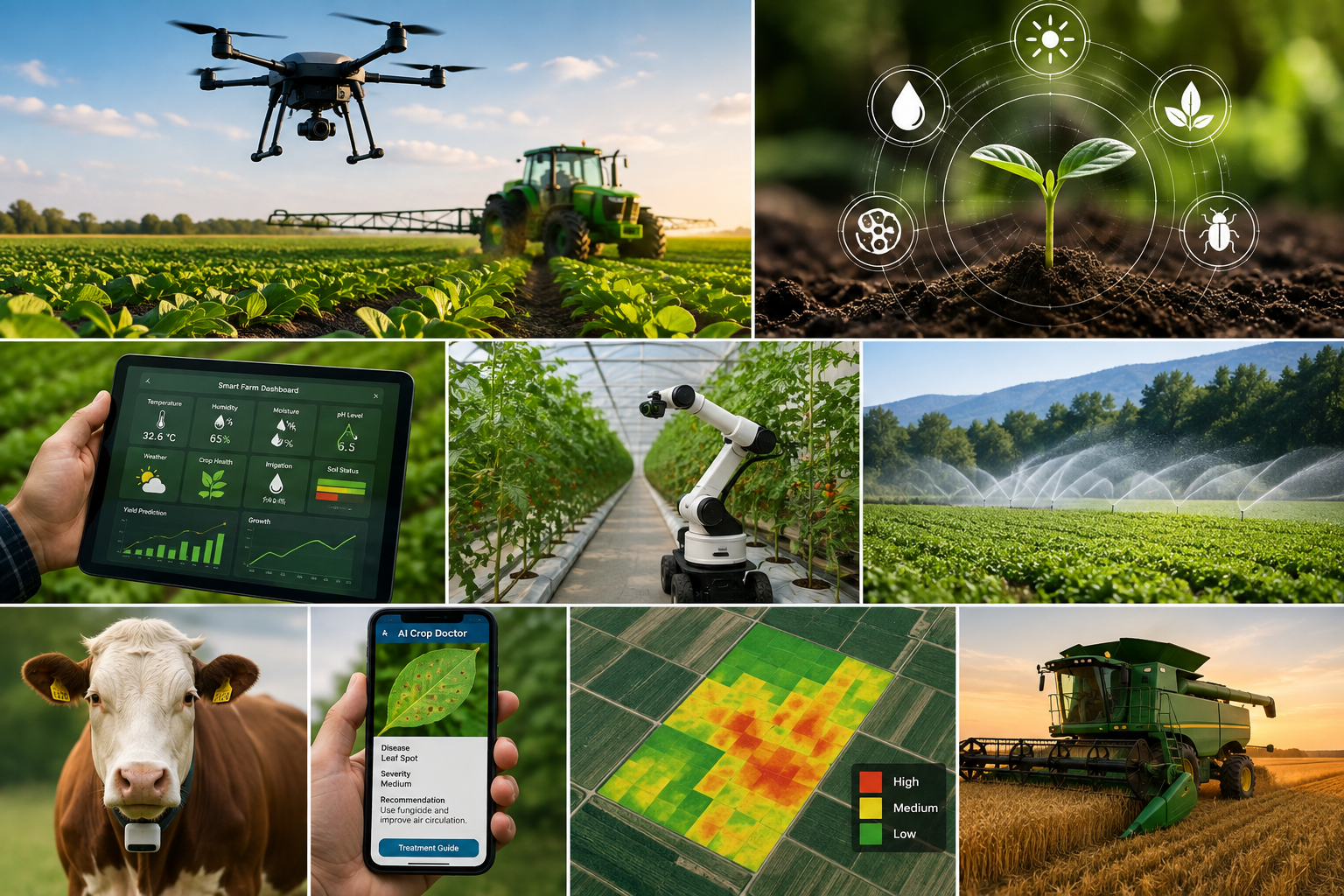
Artificial Intelligence (AI) in Agriculture: Complete Guide (2026 & Beyond)
Part 1: Introduction, Fundamentals, Benefits, Applications, and Latest Trends
Introduction
Artificial Intelligence (AI) is transforming agriculture into a smarter, more efficient, and sustainable industry. Modern farming is no longer based only on experience and manual observation. Farmers increasingly use AI together with sensors, drones, satellite imagery, weather data, and farm management software to make better decisions, reduce costs, improve crop yields, conserve water, and detect diseases earlier. Precision agriculture, autonomous equipment, and AI-driven advisory systems are becoming key technologies in modern farming. (OECD)
What is AI in Agriculture?
AI in agriculture refers to the use of machine learning, computer vision, robotics, natural language processing, and predictive analytics to improve farming operations.
AI systems analyze information collected from:
- Soil sensors
- Weather stations
- Satellite images
- Drone cameras
- Farm machinery
- Historical crop data
- Market prices
- Livestock monitoring devices
Based on this information, AI provides recommendations that help farmers make informed decisions.
Why AI is Important in Agriculture
Agriculture faces several major challenges:
- Climate change
- Water scarcity
- Rising production costs
- Labor shortages
- Crop diseases
- Pest infestations
- Soil degradation
- Increasing global food demand
AI helps address these issues by enabling:
- Precision farming
- Early disease detection
- Smart irrigation
- Yield prediction
- Automated machinery
- Better resource management
Governments, researchers, and agribusinesses are increasingly promoting AI because it can improve productivity while supporting sustainable farming practices. (OECD)
Evolution of Agriculture
Traditional Farming
- Manual labor
- Rain-dependent irrigation
- Limited crop monitoring
- Experience-based decisions
Mechanized Farming
- Tractors
- Harvesters
- Irrigation pumps
Precision Farming
- GPS guidance
- Sensors
- Satellite monitoring
- Variable-rate fertilizer application
AI-Powered Smart Farming
- Predictive analytics
- Autonomous machinery
- AI crop monitoring
- Real-time recommendations
- Robotics
- Drone-based crop inspection
How AI Works in Agriculture
AI follows a continuous decision-making cycle:
- Collects farm data.
- Processes large datasets.
- Identifies patterns.
- Predicts future conditions.
- Recommends actions.
- Learns from results to improve future recommendations.
Key Technologies Used
Machine Learning
Predicts:
- Crop yield
- Disease outbreaks
- Irrigation needs
- Fertilizer requirements
Computer Vision
Analyzes images to detect:
- Plant diseases
- Weed growth
- Fruit maturity
- Crop stress
Internet of Things (IoT)
IoT devices monitor:
- Soil moisture
- Temperature
- Humidity
- Water levels
- Equipment performance
Drones
Drones capture high-resolution images for:
- Crop health analysis
- Pest detection
- Fertilizer spraying
- Field mapping
Robotics
Agricultural robots perform:
- Planting
- Weeding
- Harvesting
- Fruit picking
- Greenhouse monitoring
Latest AI Applications in Agriculture (2026)
Precision Farming
Precision farming uses AI to optimize every part of crop production.
AI helps determine:
- When to plant
- How much fertilizer to apply
- Where irrigation is needed
- Which areas require pest control
This improves productivity while reducing waste. (DLL Group)
Smart Irrigation
Water shortages are a growing concern.
AI combines:
- Weather forecasts
- Soil moisture data
- Crop growth stage
- Evaporation rates
to recommend exactly when and how much to irrigate, helping conserve water and improve crop health. (Intellias)
Crop Disease Detection
AI detects diseases before they become visible to the human eye.
It identifies:
- Leaf spots
- Fungal infections
- Bacterial diseases
- Nutrient deficiencies
Early detection allows timely treatment, reducing crop losses. Recent research combining cloud, edge computing, IoT, and deep learning has demonstrated disease detection rates around 92–95% for tomato crops. (arXiv)
Pest Detection
Computer vision systems identify:
- Insect attacks
- Pest infestation hotspots
- Weed growth
Farmers receive alerts and can apply treatments only where needed, reducing pesticide use.
Yield Prediction
AI predicts crop production using:
- Weather forecasts
- Soil conditions
- Satellite imagery
- Historical yields
Accurate forecasts help farmers plan harvesting, storage, transportation, and marketing. New commercial AI systems are also improving long-range grain forecasting by combining weather, satellite, and market data. (The Australian)
AI in Soil Management
Healthy soil is essential for sustainable farming.
AI evaluates:
- Soil nutrients
- Organic matter
- Moisture
- pH
- Salinity
It recommends:
- Fertilizer quantity
- Nutrient correction
- Crop rotation
- Soil improvement techniques
AI in Weather Forecasting
Weather greatly affects agriculture.
AI predicts:
- Rainfall
- Temperature
- Wind
- Humidity
- Frost
- Heat waves
Farmers can plan irrigation, spraying, and harvesting more effectively.
AI for Fertilizer Optimization
AI determines:
- Which fertilizer to use
- How much fertilizer is needed
- Where fertilizer should be applied
Benefits include:
- Lower costs
- Reduced environmental impact
- Higher yields
- Healthier soil
AI for Greenhouse Farming
AI-powered greenhouses automatically control:
- Temperature
- Humidity
- Ventilation
- Lighting
- Irrigation
- Carbon dioxide levels
This helps maximize production while reducing manual intervention.
AI in Livestock Farming
AI improves livestock management by monitoring:
- Animal health
- Feeding behavior
- Milk production
- Movement
- Breeding cycles
Wearable sensors and cameras can alert farmers to illness or unusual behavior early.
AI and Agricultural Drones
Modern drones are used for:
- Crop inspection
- Field mapping
- Disease detection
- Fertilizer spraying
- Pesticide application
- Plant counting
Benefits:
- Faster field coverage
- Reduced labor
- Lower chemical usage
- Improved accuracy
AI and Agricultural Robots
Autonomous robots can:
- Plant seeds
- Remove weeds
- Harvest fruits and vegetables
- Monitor crop growth
- Spray targeted treatments
Researchers are also developing lower-cost AI-enabled agricultural robots to make automation more accessible for small farms. (arXiv)
AI in Climate-Smart Agriculture
Climate change is making farming less predictable.
AI helps farmers:
- Select climate-resilient crops
- Optimize irrigation
- Anticipate extreme weather
- Improve resilience to droughts and floods
Researchers are combining AI with plant genomics to develop crops better suited to changing environmental conditions. (The Times of India)
Benefits of AI in Agriculture
| Traditional Farming | AI-Powered Farming |
|---|---|
| Manual monitoring | Real-time monitoring |
| Fixed irrigation | Smart irrigation |
| General fertilizer use | Precision fertilizer application |
| Late disease detection | Early AI detection |
| Manual field inspection | Drone and satellite monitoring |
| Experience-based decisions | Data-driven recommendations |
| Higher resource waste | Optimized resource use |
Conclusion (Part 1)
Artificial Intelligence is transforming agriculture from traditional, labor-intensive practices into a modern, data-driven industry. Farmers can now make faster and more accurate decisions using AI-powered tools for crop monitoring, irrigation, disease detection, and yield prediction. The latest developments in 2026 show AI becoming more practical, with field-ready advisory systems, robotics, climate-resilient farming, and integrated precision agriculture helping improve productivity and sustainability. (CropLife)
Part 2: AI in Crop Production, Smart Farming, Livestock, Supply Chain, Government Initiatives, and Future Trends
AI in Crop Production
Crop production is the heart of agriculture. Artificial Intelligence helps farmers improve crop quality, increase productivity, reduce production costs, and make better decisions throughout the farming cycle.
AI analyzes large amounts of agricultural data, including:
- Soil quality
- Weather conditions
- Water availability
- Crop growth stages
- Pest activity
- Historical production data
Using this information, AI recommends the best farming practices for maximum yield.
AI in Seed Selection
Choosing the right seeds is one of the most important decisions in farming.
AI helps farmers select seeds based on:
- Climate conditions
- Soil type
- Rainfall prediction
- Disease resistance
- Expected market demand
- Crop maturity period
Benefits
- Higher germination rate
- Better crop quality
- Increased productivity
- Reduced farming risks
AI for Smart Crop Planning
Before planting begins, AI helps farmers decide:
- Which crop to grow
- Best planting dates
- Field preparation methods
- Water requirements
- Fertilizer schedules
AI compares weather forecasts, historical production data, and market prices to recommend the most profitable crop.
AI in Precision Agriculture
Precision Agriculture is one of the biggest innovations in modern farming.
Instead of treating the entire field equally, AI analyzes each section individually.
AI Measures
- Soil moisture
- Crop health
- Nutrient levels
- Weed density
- Pest infestation
- Temperature
- Water stress
This enables farmers to apply resources only where needed.
Advantages
- Saves fertilizer
- Saves water
- Reduces pesticide usage
- Improves crop quality
- Lowers production cost
AI for Crop Monitoring
Traditional crop monitoring requires farmers to inspect fields manually.
AI continuously monitors crops using:
- Drones
- Satellite images
- Smart cameras
- IoT sensors
- Mobile applications
AI Detects
- Yellow leaves
- Water stress
- Nutrient deficiencies
- Disease symptoms
- Weed growth
- Pest attacks
Farmers receive instant alerts, enabling quick corrective action.
AI-Based Irrigation Management
Water conservation is becoming increasingly important due to climate change.
AI-powered irrigation systems automatically determine:
- When to irrigate
- How much water to use
- Which field requires irrigation
- Best irrigation timing
Benefits
- Saves water
- Prevents over-irrigation
- Improves plant health
- Reduces electricity costs
AI for Fertilizer Management
Fertilizers improve crop production but excessive use damages soil and the environment.
AI analyzes:
- Soil nutrients
- Crop stage
- Weather
- Previous fertilizer usage
It recommends:
- Correct fertilizer type
- Exact quantity
- Proper application timing
This improves both productivity and sustainability.
AI for Weed Detection
Weeds compete with crops for nutrients, sunlight, and water.
Computer vision systems identify weeds using cameras mounted on drones or tractors.
Benefits include:
- Targeted herbicide spraying
- Reduced chemical usage
- Lower labor costs
- Better crop health
AI for Pest Management
AI identifies pests before severe damage occurs.
Monitoring methods include:
- Smart insect traps
- Camera-based detection
- Image recognition
- Environmental sensors
AI predicts the likelihood of pest outbreaks and recommends appropriate preventive measures.
AI in Greenhouse Farming
Greenhouse farming is becoming smarter with AI.
AI automatically controls:
- Temperature
- Humidity
- Light intensity
- Ventilation
- Irrigation
- Carbon dioxide concentration
Benefits
- Higher crop quality
- Increased production
- Reduced labor
- Efficient resource use
AI in Hydroponics and Vertical Farming
Hydroponics and vertical farming rely heavily on automation.
AI manages:
- Nutrient solutions
- Water quality
- Lighting schedules
- Temperature
- Plant growth
- Harvest timing
These technologies are ideal for urban agriculture where land is limited.
AI in Fruit and Vegetable Farming
AI assists fruit and vegetable growers by:
- Estimating fruit maturity
- Detecting diseases
- Counting fruits
- Predicting harvest dates
- Monitoring growth
Robotic harvesting systems are increasingly used for crops such as tomatoes, strawberries, apples, and cucumbers.
AI in Livestock Farming
Livestock farming benefits from AI through improved health monitoring and farm management.
AI Monitors
- Animal movement
- Body temperature
- Feeding habits
- Water intake
- Milk production
- Breeding cycles
Wearable sensors and smart cameras provide real-time insights into animal welfare.
AI in Dairy Farming
Dairy farms use AI to monitor:
- Milk production
- Cow health
- Nutrition
- Reproductive cycles
- Disease symptoms
Benefits include:
- Higher milk quality
- Improved herd management
- Early disease detection
- Better productivity
AI in Poultry Farming
AI helps poultry farms monitor:
- Bird health
- Feed consumption
- Egg production
- Temperature
- Air quality
Computer vision systems can identify abnormal bird behavior, allowing early intervention.
AI in Fisheries and Aquaculture
Aquaculture operations use AI to:
- Monitor water quality
- Predict fish growth
- Optimize feeding schedules
- Detect diseases
- Improve oxygen management
These technologies help increase production while reducing waste.
AI in Agricultural Machinery
Modern farming equipment increasingly includes AI capabilities.
Smart Machines
- Autonomous tractors
- Robotic harvesters
- AI seed planters
- Smart sprayers
- Driver-assistance systems
These machines improve efficiency and reduce dependence on manual labor.
AI in Agricultural Supply Chain
Agriculture extends beyond production to storage, transportation, and distribution.
AI optimizes:
- Harvest planning
- Warehouse management
- Cold storage
- Transportation routes
- Inventory management
- Delivery scheduling
This helps reduce food loss and improves supply chain efficiency.
AI in Market Price Prediction
AI analyzes:
- Historical prices
- Weather conditions
- Production forecasts
- Consumer demand
- Market trends
Farmers can make informed decisions about when and where to sell their produce.
AI for Farm Management
Modern AI farm management systems help farmers manage:
- Crops
- Livestock
- Machinery
- Financial records
- Labor
- Inventory
- Weather forecasts
- Farm profitability
Many platforms also provide mobile access, allowing farmers to monitor operations remotely.
AI in Sustainable Agriculture
AI supports environmentally responsible farming by:
- Reducing water consumption
- Lowering fertilizer use
- Optimizing pesticide application
- Conserving soil
- Reducing greenhouse gas emissions
- Supporting biodiversity through targeted resource management
Government Initiatives Supporting AI in Agriculture (India)
India is promoting digital agriculture through initiatives such as:
- Digital Agriculture Mission
- AgriStack
- Smart farming pilots
- AI-based crop advisory services
- Precision farming projects
- Weather advisory systems
- Digital soil health initiatives
These programs aim to improve farmer productivity, resource efficiency, and access to technology.
Challenges of AI in Agriculture
Despite its benefits, AI adoption faces several challenges:
- High initial investment
- Limited internet connectivity in rural areas
- Lack of digital literacy
- Small landholdings
- Data privacy concerns
- Equipment maintenance costs
- Need for farmer training
Addressing these issues requires collaboration among governments, technology providers, educational institutions, and farming communities.
Best Practices for Using AI in Agriculture
- Start with one or two AI tools before expanding.
- Use reliable soil and weather data.
- Regularly calibrate sensors and equipment.
- Combine AI insights with farmer experience.
- Monitor results and adjust farming practices.
- Protect farm data with secure digital systems.
- Train farm workers to use AI technologies effectively.
Future of AI in Agriculture (2030–2050)
In the coming decades, agriculture is expected to become increasingly autonomous.
Future developments may include:
- Fully autonomous farms
- AI-powered robotic harvesting
- Advanced climate prediction systems
- Digital twins for farms
- Swarm drones for crop monitoring
- AI-assisted plant breeding
- Intelligent food supply chains
- Carbon-smart farming systems
- Greater integration of AI with satellites and IoT
These innovations aim to increase food production while using fewer natural resources.
Comparison: Traditional Farming vs AI-Powered Farming
| Traditional Farming | AI-Powered Farming |
|---|---|
| Manual crop inspection | Real-time AI monitoring |
| Fixed irrigation schedules | Smart irrigation based on soil data |
| General fertilizer application | Precision nutrient management |
| Manual record keeping | Digital farm management |
| Reactive pest control | Predictive pest detection |
| Limited weather planning | AI-driven weather forecasting |
| Manual machinery | Autonomous and assisted equipment |
Conclusion of Part 2
Artificial Intelligence is transforming every stage of agriculture—from seed selection and crop planning to livestock management, supply chains, and market forecasting. By combining AI with drones, sensors, robotics, and data analytics, farmers can improve productivity, reduce costs, conserve natural resources, and adapt to changing climate conditions. As technology becomes more affordable and accessible, AI will play an increasingly important role in ensuring food security and sustainable agriculture worldwide.