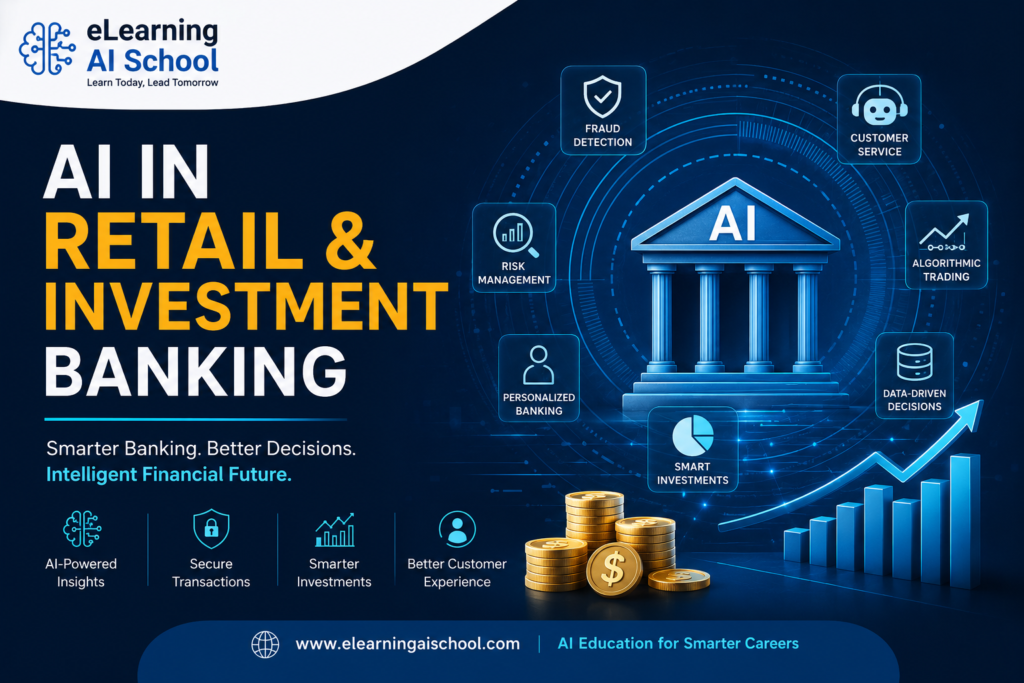
AI in Retail and Investment Banking – Benefits, Applications, Future Trends & Career Opportunities
Introduction
Artificial Intelligence (AI) has become one of the most transformative technologies in the banking and financial services industry. From personalized customer experiences in retail banking to advanced trading strategies in investment banking, AI is revolutionizing how financial institutions operate, make decisions, and serve their customers.
Banks generate massive amounts of data every day through transactions, customer interactions, investment activities, and financial operations. AI helps banks analyze this data in real time, identify patterns, predict risks, automate processes, and improve decision-making.
As digital banking continues to grow, AI is becoming a critical component of modern banking strategies. Financial institutions worldwide are investing heavily in AI technologies to improve efficiency, reduce costs, enhance security, and gain a competitive advantage.
For more information about Artificial Intelligence fundamentals, visit the official IBM AI Resource Center.
What is AI in Banking?
AI in banking refers to the use of advanced technologies such as:
- Machine Learning (ML)
- Deep Learning
- Natural Language Processing (NLP)
- Computer Vision
- Predictive Analytics
- Robotic Process Automation (RPA)
- Generative AI
- Intelligent Chatbots
These technologies help banks automate tasks, analyze customer behavior, detect fraud, manage risks, improve investment decisions, and deliver personalized financial services.
Website: https://elearningaischool.com
Understanding Retail Banking
Retail banking focuses on providing financial services directly to individual customers and small businesses.
Common Retail Banking Services
- Savings Accounts
- Current Accounts
- Personal Loans
- Home Loans
- Credit Cards
- Mobile Banking
- Internet Banking
- Insurance Services
Retail banks serve millions of customers daily, making AI extremely valuable for improving efficiency and customer satisfaction.
AI Applications in Retail Banking
1. Intelligent Customer Support
AI-powered chatbots and virtual assistants provide 24/7 customer support.
Benefits
- Instant responses
- Reduced waiting times
- Improved customer satisfaction
- Lower operational costs
Example
Customers can ask questions about account balances, loan status, or transaction history through AI-powered banking assistants.
2. Fraud Detection and Prevention
Fraud is one of the biggest challenges in banking.
AI systems analyze millions of transactions in real time and identify suspicious activities.
Benefits
- Faster fraud detection
- Reduced financial losses
- Enhanced account security
- Better customer protection
Example
If an unusual credit card transaction occurs in a different country, AI can instantly flag the activity and notify the customer.
3. Personalized Banking Services
AI analyzes customer behavior and financial history.
Benefits
- Customized product recommendations
- Personalized loan offers
- Targeted investment suggestions
- Improved customer engagement
Example
AI may recommend a savings plan based on a customer's spending habits.
4. Credit Scoring and Loan Approval
Traditional loan approval processes can be slow and complex.
AI evaluates customer financial data and predicts repayment capability.
Benefits
- Faster approvals
- Reduced risks
- Better lending decisions
- Increased operational efficiency
5. Financial Planning Assistance
AI-powered financial advisors help customers manage money more effectively.
Benefits
- Budget management
- Savings recommendations
- Investment guidance
- Debt reduction strategies
Understanding Investment Banking
Investment banking focuses on helping organizations raise capital, manage investments, facilitate mergers and acquisitions, and provide financial advisory services.
Core Investment Banking Activities
- Capital Raising
- IPO Management
- Mergers and Acquisitions
- Trading and Brokerage
- Portfolio Management
- Wealth Management
- Risk Analysis
AI is significantly transforming these operations.
AI Applications in Investment Banking
1. Algorithmic Trading
AI-powered systems analyze market conditions and execute trades automatically.
Benefits
- Faster trade execution
- Reduced human errors
- Improved profitability
- Real-time market analysis
Example
AI algorithms can evaluate thousands of market indicators and execute trades within milliseconds.
2. Market Forecasting
AI analyzes historical and real-time market data.
Benefits
- Improved investment decisions
- Better risk management
- Accurate trend prediction
- Enhanced portfolio performance
Example
Investment firms use AI models to forecast stock market trends and economic conditions.
3. Portfolio Management
AI helps investment managers optimize asset allocation.
Benefits
- Better diversification
- Improved returns
- Lower investment risks
- Automated portfolio rebalancing
4. Risk Assessment
Financial markets involve significant risks.
AI identifies potential threats and investment risks before they impact portfolios.
Benefits
- Early risk detection
- Better regulatory compliance
- Improved decision-making
- Reduced financial losses
5. Mergers and Acquisitions (M&A)
AI assists investment bankers by analyzing large volumes of corporate and financial data.
Benefits
- Faster due diligence
- Better company valuations
- Improved deal analysis
- Reduced research time
AI Technologies Used in Banking
Machine Learning (ML)
Machine learning models learn from financial data and improve predictions over time.
Natural Language Processing (NLP)
NLP enables AI systems to understand customer queries, financial documents, and market reports.
Predictive Analytics
Predictive analytics helps banks forecast customer behavior and market trends.
Robotic Process Automation (RPA)
RPA automates repetitive banking tasks such as document verification and data entry.
Computer Vision
Computer vision helps verify customer identities and process documents.
Generative AI
Generative AI assists with report creation, customer communication, and financial analysis.
Learn more about banking technology innovations through Microsoft AI for Financial Services.
Benefits of AI in Retail and Investment Banking
Improved Customer Experience
AI delivers faster and more personalized banking services.
Enhanced Security
AI continuously monitors transactions for suspicious activities.
Reduced Operational Costs
Automation reduces manual work and improves efficiency.
Better Decision Making
AI provides data-driven insights for financial decisions.
Faster Transactions
AI streamlines banking operations and payment processing.
Improved Regulatory Compliance
AI helps banks comply with financial regulations and reporting requirements.
Increased Revenue Opportunities
Personalized financial products improve customer engagement and profitability.
Real-World Examples of AI in Banking
Retail Banking
- AI Chatbots
- Mobile Banking Assistants
- Fraud Detection Systems
- Smart Loan Approval Platforms
Investment Banking
- Algorithmic Trading Systems
- AI-Powered Risk Analysis
- Portfolio Optimization Platforms
- Automated Research Tools
Many leading financial institutions are adopting AI to enhance their services and remain competitive in a rapidly evolving market.
Future of AI in Banking
The future of banking will be increasingly intelligent, automated, and customer-centric.
Emerging Trends
- AI-Powered Digital Banks
- Hyper-Personalized Financial Services
- Advanced Fraud Prevention Systems
- AI Wealth Advisors
- Autonomous Investment Platforms
- Generative AI Financial Assistants
- Real-Time Risk Management
- AI-Driven Regulatory Compliance
As AI technology continues to evolve, banks will become more efficient, secure, and responsive to customer needs.
Career Opportunities in AI Banking
The growing adoption of AI is creating exciting career opportunities in the banking sector.
Popular Job Roles
- AI Engineer
- Machine Learning Engineer
- Financial Data Analyst
- Quantitative Analyst
- Risk Management Specialist
- Fraud Detection Analyst
- Financial Technology (FinTech) Consultant
- Data Scientist
- AI Product Manager
- Banking Automation Specialist
Conclusion
Artificial Intelligence is transforming both retail banking and investment banking by enabling smarter decision-making, enhanced security, personalized customer experiences, and improved operational efficiency. From fraud detection and customer support to algorithmic trading and portfolio management, AI is helping financial institutions deliver better services while reducing costs and risks.
Banks that embrace AI today are positioning themselves for long-term success in the digital economy. As technology advances, AI will continue to shape the future of banking, creating smarter financial systems, better customer experiences, and new opportunities for innovation.